Directories and wayfinding
Levels, zones, lifts and car parks — the question every visitor arrives with.
Shopping centres and malls
A centre runs two estates at once: the wayfinding that has to be right, and the commercial screens that pay for it. Both are compositions in the same library, published to the same facility.
Plans, prices and trials are set by your ScreenQube partner.
Where it ends up
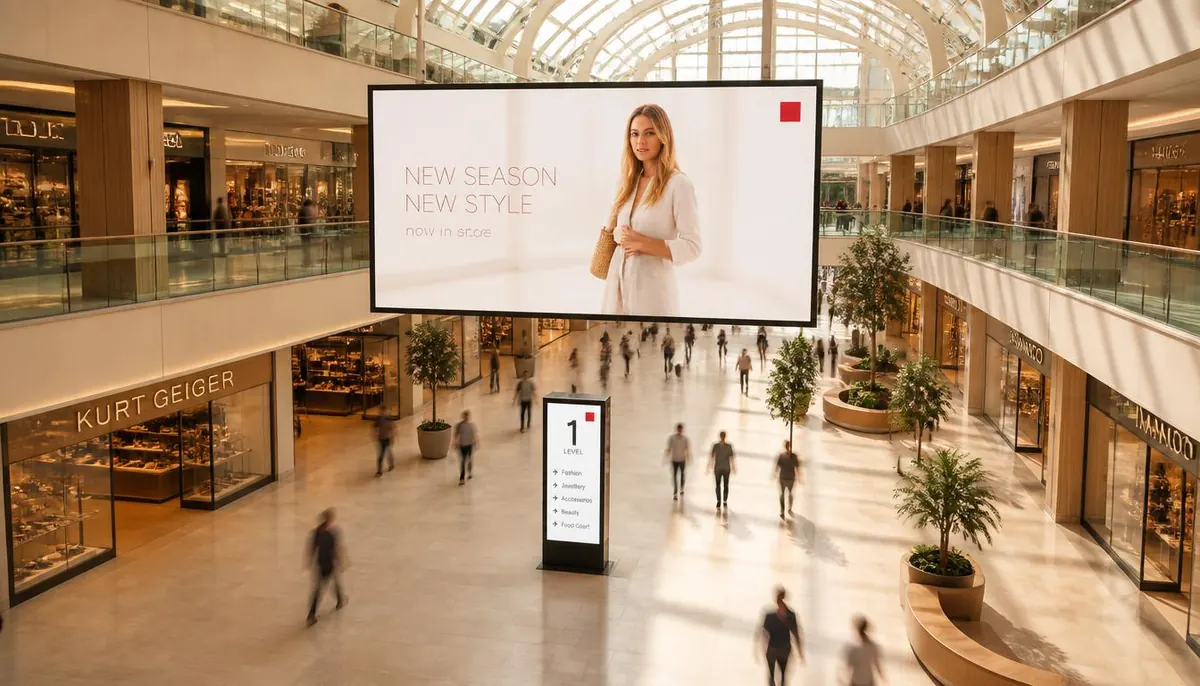
The screen above is what you publish. This is where it ends up — a display a customer stands in front of, driven by a player that fetched it on its own.
What goes on the screens
Every one of these is ordinary media, arranged in Composition and sent out by Publish. Nothing here needs a separate system.
Levels, zones, lifts and car parks — the question every visitor arrives with.
Sold to tenants, scheduled per screen, reported on afterwards.
What is on in the atrium, with an end date that arrives on its own.
Levels, entrances and exits, published as media.
One publish reaches every screen in the centre.
The largest screen in the building, driven by the same library as the smallest.
Where the screens go
Wayfinding first, the campaign second.
Where people are deciding which way to go.
Menus and tenant offers in one place.
Entry, exit and level information.
How it is run
The same four steps whether you have four screens or four hundred. This is the real console, not an illustration.
One facility per site, branch or building. A screen joins by showing a registration code, which you type in once. Switch between facilities from the header.
Media goes into the library, in folders, with tags. Composition arranges it into zones — your own files, plus App Store apps like weather, news or a ticker.
On a schedule, with day sequences. Or QuickPlay, which the console describes as displaying content instantly for a flash sale or an emergency. Or as the default composition a screen falls back to.
Live Monitoring reports each screen's state. Take Screenshot shows what one is really displaying. Reload, clear the cache or reboot it remotely.
What it fixes
Set it up as
Nearby
Questions
Touch interaction has not been observed in the console. Published directories are playback content.
Yes. Each centre is a facility with its own screens and its own default.
Users belong to groups, and groups decide what a person can reach.
An Android player app, the same as every other screen.
Talk to us about becoming the partner who sells it.
We will introduce you to the partner who covers your region.